Friday, 11 August 2017

What is marketing plan

MARKETING PLAN
A marketing plan is a comprehensive document or blueprint that outlines a company's advertising and marketing efforts for the coming year. It describes business activities involved in accomplishing specific marketing objectives within a set time frame.
CONTENTS OF MARKETING PLANS
·        Executive Summary.
·        Situational Analysis.
·        Opportunities / Issue Analysis - SWOT Analysis.
·        Objectives.
·        Marketing Strategy.
·        Tactics.
·        Budget.

·       Executive summary
Begin your marketing plan with a one page summary of the circumstances and principal recommendations contained in the plan.
Summary allows everyone to grasp quickly the main thrust of the plan and then lets them read further in search of the information most critical to his or her part in it.

·       Situation analysis
This section describes where your company stands at that moment in time .
It includes background on past sales, major competitors, and explanations of recent sales and profit result.
It should also feature a forecast for the industry, including opportunities and threats and some mention of the company’s strengths and weakness versus the competition.

·       Objectives
Every company has objectives. They are simply a matter of deciding where you want to get there
Is the purpose of your marketing plan to launch a new product or line of products?
If so, your objecting might read, achieve 10% market share within the first 12 months of products launch.
Is the purpose of your marketing plan to boost revenue from existing product?
Your objective then might read, increase revenue 12& from our existing line of products over the next six months while maintaining current profit margins.

·       Strategies
Strategies are the things you need to do to accomplish your objectives. If you where you want your company to be the strategy is the route you need to take to get there.
For example, if the objective is to increase sales revenue your strategies might be one or more of the following:
à Increase the average price on all units.
à Increase overall sales volume.
à Sell more of the higher priced units.
à Any combination of these.

·       Tactics
Increase awareness among potential customers is a strategy. Develop a brochure to send to new prospects is simply a tactic for implementing that strategy.
·       Budget

Of course each tactic has a price. Add up all that you plan to use and you know what your budget must be to achieve your goals.

Wednesday, 9 August 2017

What are the pros, cons, and risks associated with Nike’s core marketing strategy?

What are the pros, cons, and risks associated with Nike’s core marketing strategy?

Ø INTRODUCTION OF NIKES BRAND
Nike is a major publicly traded sportswear, footwear and equipment supplier based in the US which was founded in 1962 originally know as Blue Ribbon Sports. Nike produces a wide range of sports equipments such as running shoes, sportswear, football, basketball, tennis, golf, etc. Nike recently teams up with Apple Company to produce the Nike+ products which can monitor a runner's performance through a radio in the shoe that can link to the iPods. Besides that, Nike also becomes the top of three companies which are climate-friendly companies which build better image to customers. 

Ø PROS OF NIKE'S CORE MARKETING STRATEGY
 Nike actively responds to the market trends and changes in consumer preference by adjusting their marketing strategies, the mix of existing product offerings, developing new products, styles and categories, and influencing sports and fitness preferences through various marketing strategies.

·        Nike's core marketing strategies 
DISTRIBUTION
 Nike distributes its products on different level basis. The high premium products are given to a certain distributors while leaving the low priced to be sold at highly discounted price at the retail stores such as Wal-Mart (Jeannet J, 200, pp 44).


ADVERTISING AND PROMOTION
Nike makes contracts with some celebrity athletes which can draw attention to their products such as Tiger Woods, Ronaldo.  Their aggressive advertising campaigns, celebrity endorsements and quality products all enhance their brand and image. For example, when a celebrity athlete sponsors a specific brand of athletic shoes, the brand will be associated with success.
PRICE
Nike targets on the consumers who care more about the utility and quality of the products rather than the price. In this way, the price is not affect too much.
MARKET SEGMENTATION AND TARGET
Most of the consumer of Nike's products is mainly athletic. Nike is the master of segmentation, their segmenting market typically target's athletes, both women and men from the age 15 to 35. Nike's targeting market is active people who enjoy high quality sporting goods, especially footwear. Nike focuses on creating premium consumer experiences on product innovation, brand leadership and elevated retail presence.
·       CONS OF NIKE'S CORE MARKETING STRATEGY
Although Nike's marketing strategies had brings lot of positive implications to the company, but it will bring negative implications to Nike too. The negative implications that will identify in this assignment are high cost incurred, influence of spokesperson, and competitors.
COSTLY
 The costs are increase among handling inventory, designing, advertising and production. (Abhiroopsur, 2009) Beyond that, the inflation had raised the costs of raw materials and transportation. To deal with these problems, Nike has increased the products' prices and reduces its marketing budget. Therefore, this could hurt the long-term growth of the Nike.
INFLUACE AND SPOKEPERSONES
 The athletes had positive and negative influence on changing consumer preferences, changes in consumer tastes and priorities, and also consumers' buying decisions. The action and attitude of Nike's chosen spokespersons could bring the impacts on its promotional strategies. For instance, it will attract the athlete's idolater to purchase the products if Nike using a popular athlete as endorser.
INTENSE COMPETITORS
There is intense competition faced by Nike. Their competitors are Adidas, Reebok, Puma, and so forth, whilst competition is tighter with the coming of Adidas. More, the product line is slightly different between Nike and Adidas. 
·        RISKS OF NIKE'S CORE MARKETING STRATEGY
Nike faces many risks when they use their core marketing strategies to achieve their goals and these risks can come from both internally and externally environmental circumstance. The risks will have a negative influence about Nike's future development, for example, the market share in the world, reputation, brand image and customer loyalty.
Changes in Market Trends, Consumer Tastes and Preference
Nike needs to stay on the top of changes in consumer taste and preferences as evidenced by changes in fashion. So Nike face the risk that fashion trends may change so fast that Nike fails to follow. For example, for a period, the global athletic sportswear is focus on personality and Nike's products still be general to the customers this will lead Nike go behind of their competitors if their competitors can follow the trends. 


Fast changing of Nike's products
 Nike change its marketing strategies and products design to become more fashion and focus on the youth consumers. It brings risks to Nike because in the traditional mind of customers, they consider Nike only sell the athletic products. The fashion or the changing style products is unimaginative for customers to purchase.
If you are adidas, how would you with Nike?
 If I were adidas I would compete with Nike by following strategies.
If I were adidas I would emphasize my international scope of producing great soccer shoes and could extend my marketing to emphasize every day every one usage for my product. I had look into rebranding the adidas image as a life style shoe company.
·        Innovative products
I would make this possible by creating a strong brand based on high quality, innovative products that top athletes chose to use in training and competition.
·        Chose winning team
Adidas can gain its recognitions as providing the winning team with the shoe needed for victory but also marketing to the consumer a specific adidas product.
·        Target market
I would create a premium product but target it to young people, women and other who are in fashionable shoes.
·        Emerging market

I would compete with Nike is by focusing on emerging market such in Asia and Latin America by giving adidas significant leverage over Nike.

Pakistan Stock Exchange

Pakistan stock exchange
History
Pakistan Stock Exchange Limited (PSX) (formerly: Karachi Stock Exchange (Guarantee) Limited (KSE) was established on September 18, 1947. It was incorporated on March 10, 1949. Only five companies were initially listed with a total paid-up capital of 37 million rupees.
In October 1970, under the Securities and Exchange Ordinance of 1969 by the Government of Pakistan, a second stock exchange was established in Lahore in response to the needs of the provincial metropolis of the province of Punjab
Yet another stock exchange known as Islamabad Stock Exchange was established in Islamabad, the capital city of Pakistan on October 25, 1989 with the main object of setting up of a trading and settlement infrastructure, information system,
Advantages of stock exchange
·         Liquidity
·         Best price of securities
·         Transparency in dealing
·         Enable the management to boarden and diversify  shareholding
·         Helps the company to gain national importance and wide spread recognition
·         Help in rising additional capital

BCG ANALYSIS OF PEPSICO COMPANY

BCG ANALYSIS OF PEPSICO COMPANY

Overview of the Company
PepsiCo Inc. is one of the world’s leading food and Beverage Company.  PepsiCo started on 1965, during that time Pepsi-Cola’s CEO and President  approached ,  Chairman and CEO with a proposition of merging the two company in providing food and beverage with complementary products that would give a lesser opportunity for cost sharing, joint merchandising and knowledge and skill transfer. Its expertise is to create different food and beverage products that would soothe the taste of its consumer.  The new company was founded with annual revenues of $510 million and such well-known brands as Pepsi-Cola, Mountain Dew, Fritos, Lay’s, Chee-tos, Ruffles, and Rold Gold. PepsiCo’s roots can be traced to 1898, when , a pharmacist in New Bern, North Carolina, created the formula for a carbonated beverage he named Pepsi-Cola. The reinvention of different products, the introduction of new product, expansion into international markets and clever advertising campaigns are the primary focus of PepsiCo Inc.  PepsiCo’s considerable marketing expertise could be leveraged in the marketing of fried chicken, pizza, and Mexican fast foods.
  In 2001, PepsiCo was the second-largest food products company in the United States (behind Kraft Foods) and was diversified into salty and sweet snacks, soft drinks, orange juice, bottled water, ready-to-drink teas and coffees, nutraceutical and isotonic beverages, hot and ready-to-eat breakfast cereals, grain-based products, and breakfast condiments. Many PepsiCo brands held number one or number two positions in their respective food and beverage categories ( 2008).
BCG Growth Matrix Analysis
            As mentioned above, this study aims on analyzing the products and services offered by PepsiCo. The BCG matrix approach is based on the product life cycle concepts which can be utilized to identify what priorities should be given in the product portfolio of a business level. To make sure that the company is creating long-term value, an industry should have a portfolio of products which contains both high-growth products in need of cash inputs as well as low-growth products which establishes a lot of profit or cash.
BCG matrix relies on 2 dimensions: market growth and market share. The basic notion behind it is that the higher the market share of a specific product has or the faster the product’s marketability grows, the better it is for the industry.  Placing appropriate products in the BCG matrix, results in 4 categories, in the business portfolio of an industry. The four categories include the Stars, cash cows, dogs, question marks. Each of these categories has their own measurement. First, the stars are considered as those products which have high market growth and market share. The stars products use large amounts of cash and considered to have competitive position in the business which results in generating more profit. The stars products are frequently noted as rough in balance on net cash flow. But if needed, any attempt should be created to hold market share to avoid becoming cash cow. 
The second category is Cash cows which are commonly considered to have low growth with high market share. Herein, the profits and generation of cash are considered high but because of the low market growth, the investment required should be low. It is said that cash cows should keep the profit high and is noted to be the foundation of the company. The next category is Dogs which is low market growth and share. It is noted that an industry should avoid or reduce the number of dog’s products in the industry. In addition, the company is also recommended to beware of the expensive turn around plans. The last category is question markets which is high growth with low market share. Question marks products are considered to be the worst cash features of all, because high demands make it to have low returns due to low market share. Herein, if the company would not be able to solve the issue of question market products, these may be able to absorb great amount of cash and may result from stopping dogs to grow.        
Accordingly, BCG matrix approach can help the business companies to understand a frequently made approach mistake. Boston Consulting Group Matrix is a tool used for product portfolio planning  2005). This tool has two controlling elements which includes market growth relative market share. In this manner, the current situation PepsiCo in the standpoint of the market environment will be analyzed using this marketing tool. This analysis will give emphasis on the product and service portfolio of PepsiCo.  Thus, the product and services that the company offers will be analyzed using the following figure. 
It can be said that PepsiCo products and business portfolio can be divided in four major products or services; each service operates in accordance with its functions along with the products and services in different areas especially made as a distinction of each division. The PepsiCo analysis will be based in assessment of the services offered by the company.  


THE END

Monday, 7 August 2017

Linear model of communication

 LINEAR MODEL OF COMMINICATION                   
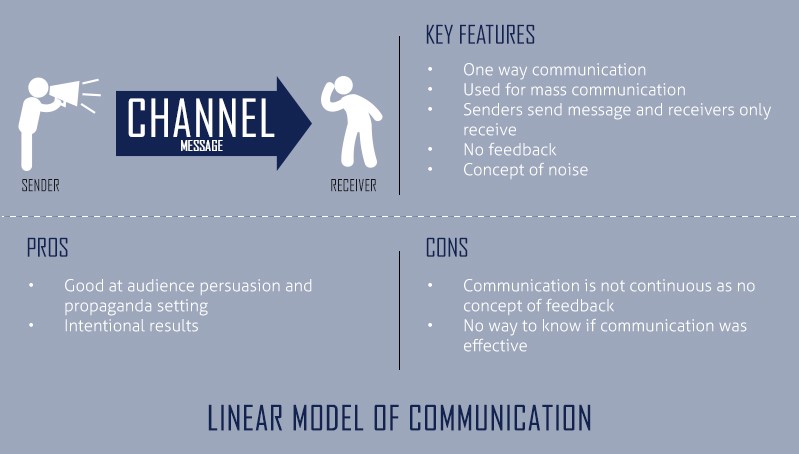
In linear model, communication is considered one way process where sender is the only one who sends message and receiver doesn't give feedback or response. The message signal is encoded and transmitted through channel in presence of noise. The sender is more prominent in linear model of communication. 
Linear model was founded by Shannon and Weaver which was later adapted by David Berlo into his own model known as SMCR (Source, Message, Channel, Receiver) Model of Communication.


Application:
Linear model is applied in mass communication like television, radio, etc. This model is not applicable in general human communication as general human communication has to have feedback and responses.
Components of Linear Communication
Linear model has defined set of components required for a communication to be established where
·         Sender is the person who sends a message after encoding.
·         Encoding is the process of converting the message into codes compatible with the channel and understandable for the receiver. 
·         Decoding is the process of changing the encoded message into understandable language by the receiver.
·         Message is the information sent by the sender to the receiver.
·         Channel is the medium through which the message is sent.
·         Receiver is the person who gets the message  after decoding.
·         Noise is the disruptions that are caused in the communication process in channel or in understandability of the message.

Types of Linear Communications
Different types of communication models based on linear model of
communication are:

Aristotle’s model
Shannon and weaver model
Berlo’s SMCR model
Laswell model
Criticisms of Linear Model
·         The model assumes that communication has a particular beginning and an end, so it is not continuous.
·         There is no concept of feedback which makes it inapplicable to direct human communication and only applicable to mass communication like newspaper, television, etc. There is no way to know if the communication was effective or not.
·         Human communication is mostly circular rather than linear as audience is also an active participant.
·         Communication may not happen in turns and more than one message can be sent at the same time.
·         The sender must have the ability to encode and the receiver must have the ability to decode.
·         The model has become less relevant to electronic communication and internet where it’s not clear who is the sender and who is the receiver.


     Aristotle's Model of Communication

Aristotle was a Greek philosopher and writer born in Stagira, Northern Greece. He was also the teacher of Alexander the Great. He studied physics, logic, mathematics, etc. While exploring the human nature scientifically, Aristotle developed a linear model of communication for oral communication known as Aristotle's Model of Communication. This is considered as the first model of communication and was proposed before 300 B.C. It is also the is most widely accepted among all communication models


Aristotle Model is mainly focused on speaker and speech. It can be broadly divided into 5 primary elements: Speaker, Speech, Occasion, Audience and Effect.
The Aristotle's communication model is speaker centered model as the speaker has the most important role in it and is the only one active. It is the speaker's role to deliver a speech to the audience. The role of the audience is passive, influenced by the speech. This makes the communication process one way, from speaker to receiver.

Application:

This model was highly used to develop public speaking skills and create propaganda at that time so, it is less focused on intrapersonal or interpersonal communication. Even if the model is speaker oriented and focuses on audience interaction in communication, there is no concept of feedbacks.
Example:
For instance, a politician (speaker) gives a speech to get votes from the civilians (audience) at the time of election (occasion). The civilians only vote if they are influenced by the things the politician says in his speech so the content must be very impressive to influence the mass and the speaker must design the message very carefully. The speech must be clear as well as the speaker must have a very good non-verbal communication with the audience like eye contact.
This example is a classic case of Aristotle Model of Communication depicting all the elements in the model.

Critical elements of a good communicator:
·         Ethos : Ethos is the characteristic which makes you credible in front of the audience.
·         Pathos: If what you say matters to them and they can connect with it, then they will be more interested and they will think you are more credible.
·         Logos : Logos is logic. People believe in you only if they understand what you are trying to say. 

Criticisms of Aristotle's Model of Communication

There are few criticisms around this model. Some of them are
·         There is no concept of feedback, it is one way from speaker to audience.
·         There is no concept of communication failure like noise and barriers.
·         This model can only be used in public speaking.


Shannon and Weaver Model Of Communication

Shannon Weaver model of communication was created in 1948 when Claude Elwood Shannon wrote an article "A Mathematical Theory of Communication" in Bell System Technical Journal with Warren Weaver. Shannon was an American mathematician whereas Weaver was a scientist. The Mathematical theory later came to be known as Shannon Weaver model of communication or “mother of all models." It is more technological than other linear models.


his model is specially designed to develop the effective communication between sender and receiver. Also they find factors which affecting the communication process called “Noise”. At first the model was developed to improve the Technical communication. Later it’s widely applied in the field of Communication.

Components of model:
Sender (Information source) – Sender is the person who makes the message, chooses the channel and sends the message.
Encoder (Transmitter) –Encoder is the sender who uses machine, which converts message into signals or binary data. It might also directly refer to the machine.
Channel –Channel is the medium used to send message.
Decoder (Receiver) – Decoder is the machine used to convert signals or binary data into message or the receiver who translates the message from signals.
Receiver (Destination) –Receiver is the person who gets the message or the place where the message must reach. The receiver provides feedback according to the message. 
Noise –Noise is the physical disturbances like environment, people, etc. which does not let the message get to the receiver as what is sent. 

Example :
A businessman sends a message via phone text to his worker about a meeting happening about their brand promotion. The worker does not receive the full message because of noise.
Communication problems in model :
There are three levels of problems of communication according to Shannon Weaver. They are:
1.   Technical problem –How a channel causes a problem
2.   Semantic problem –Is the meaning of message sent and received very different
3.   Effectiveness problem –How effectively does the message cause reaction

Advantages of Shannon Weaver Model

·         Concept of noise helps in making the communication effective by removing the noise or problem causing noise.
·         This model takes communication as a two way process. It makes the model applicable in general communication.
·         Communication is taken as quantifiable in Shannon Weaver model.

Criticisms of Shannon Weaver Model

·         It can be applied more for interpersonal communication  than group communication and mass communication.
·         Receiver plays the passive part in the communication process as sender plays the primary role that sends messages.
·         Feedback is taken as less important in comparison to the messages sent by the sender. 
·         The model is taken by some critics as a "misleading misrepresentation of the nature of human communication" as human communication is not mathematical in nature.


Berlo's SMCR Model of Communication

In 1960, David Berlo postulated Berlo's Sender-Message-Channel-Receiver (SMCR) Model of Communication from Shannon Weaver's Model of Communication . He described factors affecting the individual components in the communication making the communication more efficient. This model also focuses on encoding and decoding which happens before sender sends the message and before receiver receives the message respectively.
Components of Berlo's Model of Communication

S -Sender

Sender is the source of the message or the person who originates the message. The person or source sends the message to the receiver. The following are the factor related to sender and is also the same in the case of receiver:
·         Communication Skills:
Communication skills of a person is a factor that affects the communication process. If the sender has good communication skills, the message will be communicated better than if the sender's communication skills are not good. Similarly, if the receiver cannot grasp the message, then the communication will not be effective. Communication skills include the skills to speak, present, read, write, listening, etc.
·         Attitude:
The attitude of the sender and the receiver creates the effect of the message. The person's attitude towards self, the receiver and the environment changes the meaning and effect of the message.
·         Knowledge:
Familiarity with the subject of the message makes the communicated message have its effect more. Knowledge on the subject matter makes the communicator send the message effectively.
·         Social Systems:
Values, beliefs, laws, rules, religion and many other social factors affect the sender's way of communicating the message. It creates difference in the generation of message. Place and situation also fall under social systems.
·         Culture:
Cultural differences make messages different. A person from one culture might find something offensive which is very much accepted in another culture.

M-Message

A message is the substance that is being sent by the sender to the receiver. It might be in the form of voice, audio, text, video or other media. The key factors affecting the message are
·         Content:
Content is the thing that is in the message. The whole message from beginning to end is the content.
·         Elements:
Elements are the non verbal things that tag along with the content like gestures, signs, language, etc.
·         Treatment:
Treatment is the way in which the message is conveyed to the receiver. Treatment also effects the feedback of the receiver.
·         Structure:
The structure of the message or the way it has been structured or arranged, affects the effectiveness of the message.
·         Code:
Code is the form in which the message is sent. It might be in the form of language, text, video, etc.

C-Channel

Channel is the medium used to send the message. In mass communication and other forms of communication, technical machines might be used as a channel like telephone, internet, etc. But in general communication, the five senses of a human being is the channel for the communication flow and it affects the effectiveness of the channel.
·         Hearing- We receive the message through hearing.
·         Seeing- We perceive through seeing. We also get non-verbal messages by seeing.
·         Touching- Many of the non-verbal communication happens from touching like holding hands.
·         Smelling- We collect information from smelling.
·         Tasting- Taste also provides the information to be sent as a message.

R- Receiver

Receiver is the person who gets the message sent in the process. This model believes that the thinking pattern and all other factors mentioned above must be in sync to that of the sender for the communication to be effective. The message might not have the same effect as intended if the receiver and sender are not similar. The receiver must also have a very good listening skill. Other factors are similar to that of the sender.
·         Communication skills
·         Attitudes
·         Knowledge
·         Social Systems
·         Culture


Criticisms of Berlo's SMCR Model:

·         There is no concept of feedback, so the effect is not considered.
·         There is no concept of noise or any kind of  barriers in communication process.
·         It is a linear model of communication, there is no two way communication.
·         Both of the people must be similar according to all the factors mentioned above but not in real life.


               Lasswell’s model


Lasswell's communication model was developed by communication theorist Harold D. Lasswell (1902-1978) in 1948. Lasswell’s model of communication (also known as action model or linear model or one way model of communication)
 He states that a convenient way to describe an act of communication is to answer the following questions
§  Who
§  Says What
§  In Which Channel
§  To Whom
§  With what effect?

Lasswell's communication model has 5 components which is used as an analysis tool for evaluating the communication process and components. The components are the questions to be asked to get the answers and keep communication going.
In this model, the communication component who refers the research area called “Control Analysis”,
Says what is refers to “Content Analysis”,
In which channel is refers to “Media Analysis”,
To Whom is refers to “Audience Analysis”
With What Effect is refers to “Effect Analysis”

Explanation of different Components of Lasswell's Model

·         Control analysis helps the sender to have all the power.
·         Content analysis is associated to stereotyping and representation of different groups politically. It is also related to the purpose or the ulterior motives of the message.
·         Media analysis represents which medium should be used to exercise maximum power against the receivers.
·         Audience analysis shows who are the target population to be manipulated or brain-washed.
·         Effect analysis is done before the process starts. It is used to predict the effect of message over the target population to be exploited.

Example:
CNN NEWS – A water leak from Japan’s tsunami-crippled nuclear power station resulted in about 100 times the permitted level of radioactive material flowing into the sea, operator Tokyo Electric Power Co said on Saturday.
Who – TEPC Operator
What – Radioactive material flowing into sea
Channel – CNN NEWS (Television medium)
Whom – Public
Effect – Alert the people of Japan from the radiation.
USES AND APPLICATIONS:
Though Lasswell's model was developed to analyze mass communication, this model is used for interpersonal communication or group communication to be disseminated message to various groups in various situations.
Lasswell's model was developed to study the media propaganda of countries and businesses at that time. Only rich people used to have communication mediums such as televisions and radios back them.
. The use of the concept of effect makes Lasswell's model non-linear unlike its name. It's because effect can also be taken as feedback. Though, generally, the component of effect was made to be more about outcome of the message, the model is applied in different medias and fields despite being developed specifically for mass communication.  

Advantage of lasswell model:
§  It is Easy and Simple
§  It suits for almost all types of communication
§  The concept of effect
Disadvantage of lasswell model:
§  Feedback not mentioned
§  Noise not mentioned
§  Linear Model

Inflation in Pakistan What is inflation? The rise of price and goods and services in an economy over a period of time. When gen...